“Digital signature” is one of those phrases that means four different things depending on who’s saying it — and in India, picking the wrong one either wastes money or leaves a hole in your contract you won’t notice until it’s contested. A founder buys a ₹2,000 USB token to sign an NDA an OTP could have handled in thirty seconds. A finance team relies on a typed-name “signature” for loan documents a court can pick apart. Both mistakes come from treating every electronic signature as the same thing. They aren’t.
Here’s the plain-English version of the three you’ll actually run into, what each is for, and a simple rule for choosing.
The three signatures people lump together
When an Indian business says “we need a digital signature,” they almost always mean one of three distinct tools: Aadhaar eSign, a DSC token, or an organisational Document Signer Certificate. They sit at different price points, need different hardware, and the law treats them slightly differently. Get the category right and the rest is easy.
1. Aadhaar eSign — the everyday workhorse
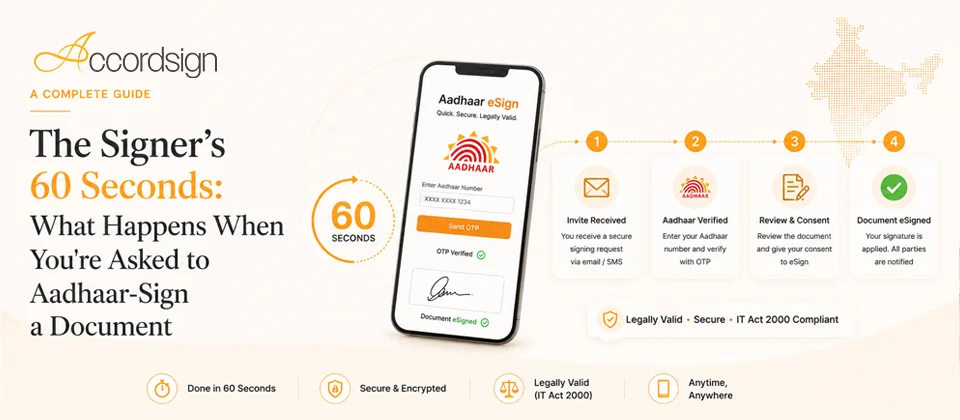
Aadhaar eSign lets any of India’s Aadhaar holders sign a document using nothing more than their Aadhaar number and a one-time password sent to their Aadhaar-linked mobile. No USB token, no software install, no in-person visit. The cryptographic signing is performed by a CCA-licensed eSign Service Provider — an entity authorised by the Controller of Certifying Authorities — so the signature is legally robust, not just a picture of a scribble.
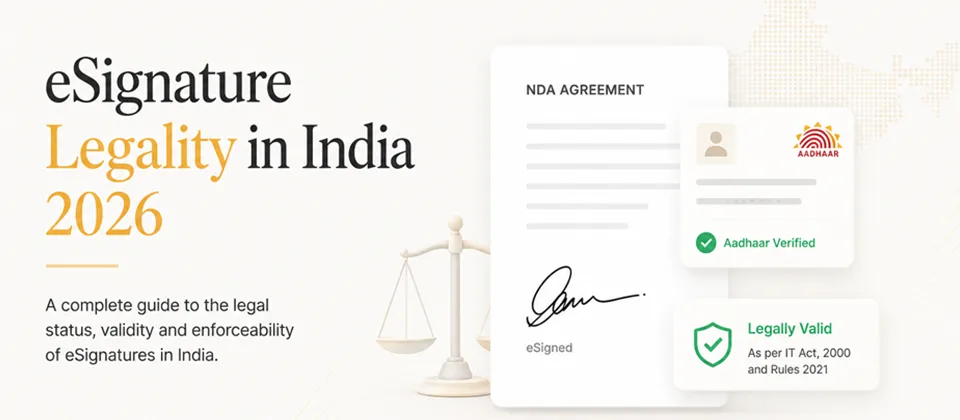
Legally, it’s recognised under Section 3A of the IT Act 2000 as an electronic signature equivalent to a handwritten one, and Aadhaar-signed records are admissible in court under Section 63 of the Bharatiya Sakshya Adhiniyam 2023 (the provision that replaced Section 65B of the old Evidence Act) when accompanied by their audit trail.
What it’s for: the overwhelming majority of business contracts — NDAs, offer letters, vendor agreements, MSAs, rental agreements, loan and KYC documents. If a human needs to sign and they have an Aadhaar, this is almost always the right tool.
2. The DSC token — for statutory filings, not everyday contracts
A DSC (Digital Signature Certificate) token is the USB device you’ve probably seen a CA or CFO plug into a Windows machine. It holds an individual’s Class 3 certificate, and signing requires the physical token plus a PIN. It’s recognised under Section 3 of the IT Act as a digital signature.
The thing to understand is what it’s actually for. You don’t need a DSC token for normal contracts — you need it for statutory filings on government portals: MCA/ROC company filings, GST, certain income-tax filings, e-tenders, EPFO, customs (ICEGATE), and DGFT foreign-trade filings. Those portals specifically demand a token-based DSC and won’t accept anything else.
The trade-offs are real: a token runs roughly ₹1,500–3,000 including a couple of years’ validity, it typically works only on Windows with specific browsers and a signing utility, and it’s tied to one person who has to be physically present with the device. Excellent for what it’s built for; painful and unnecessary for signing an offer letter.
3. The organisational Document Signer Certificate — the automated org seal
The third one is the least understood and increasingly the most important for businesses signing at volume. A Document Signer Certificate is issued to an organisation (not an individual) specifically for automated, server-side signing — sealing every invoice, statement, policy, or contract with the company’s own cryptographic signature, with no human plugging in a token each time.
Because it signs unattended, the CCA requires the certificate’s key to live in a hardware security module (HSM). The payoff is significant: the organisation’s signature is embedded directly into the PDF, so when anyone opens the document they see a valid, certificate-backed digital signature — which carries the Section 3 statutory presumption of integrity, a stronger evidentiary position than an audit-trail-only signature. This is what large lenders and utilities use to bulk-seal documents, and what a court will most readily accept without further proof.
The quick comparison
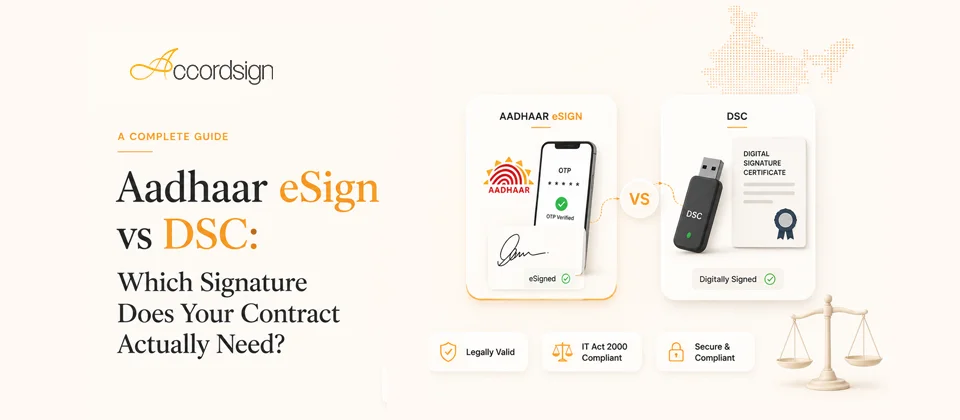
| Aadhaar eSign | DSC token | Document Signer Certificate | |
|---|---|---|---|
| What it is | OTP-based electronic signature | Individual’s certificate on a USB token | Organisation’s certificate for automated signing |
| Who signs | The individual, via Aadhaar OTP | The individual, with the physical token | The organisation, server-side |
| Hardware | None | USB token (Windows only) | HSM (server-side) |
| Typical cost | ~₹20 per signature | ₹1,500–3,000 + renewal | Higher fixed setup, near-zero per document |
| Best for | Most business contracts | Government / statutory filings | Bulk, automated document sealing |
| Legal basis | IT Act §3A | IT Act §3 | IT Act §3 |
The decision rule
It comes down to one question: who is signing, and why?
A person signing a business contract — an NDA, an offer letter, a service agreement — needs Aadhaar eSign. It’s faster, cheaper, and legally valid for the vast majority of agreements. A person filing on a government portal needs a DSC token, because the portal demands it. An organisation that needs to seal documents in bulk, automatically, with the strongest possible court-ready signature needs a Document Signer Certificate. Most businesses need the first far more often than they think, and the second far less.
One caveat worth knowing
Indian law excludes a small set of documents from electronic signing altogether — wills, certain negotiable instruments, powers of attorney for property registration, and some real-estate deeds (which vary by state). No electronic signature, Aadhaar or DSC, covers those; they still need wet ink. When a document is high-value or unusual, it’s worth a quick check with a lawyer. We keep an honest list of the exclusions on our Aadhaar eSign page.
Where Accordsign fits
For the everyday case — the contracts your team actually sends every week — Accordsign includes Aadhaar eSign on every plan at a flat ₹20 per signature, with a full audit trail on every envelope, and it works natively inside Salesforce so you can send for signature without leaving the record you’re working in. If you’re signing with people who don’t have Aadhaar — NRIs, foreign counterparties — the standard electronic signature workflow is legally valid and works worldwide.
Want the deeper background? Start with Aadhaar eSign, explained and Is an electronic signature legally valid in India?.