Short answer: yes, electronic signatures are legally valid in India — and they have been since the year 2000. For the vast majority of business contracts, an electronic signature carries the same legal weight as ink on paper.
The longer answer is where it gets useful. Indian law recognises e-signatures through a specific framework, accepts only certain techniques as legally robust, and excludes a short list of document types entirely. Get those details right and your signed records hold up. Get them wrong and you have a document that looks signed but won’t survive a challenge.
This guide walks through the whole picture in plain English: the laws that make e-signatures valid, the two techniques that actually count, what you can and can’t sign, and what an audit trail needs to contain to be admissible in court.
A note on what this is. This is general information for Indian businesses, not legal advice. The law is settled on the broad strokes below, but your specific contract, industry, or state may carry additional requirements. When the stakes are high, ask a lawyer.
Are electronic signatures legal in India?
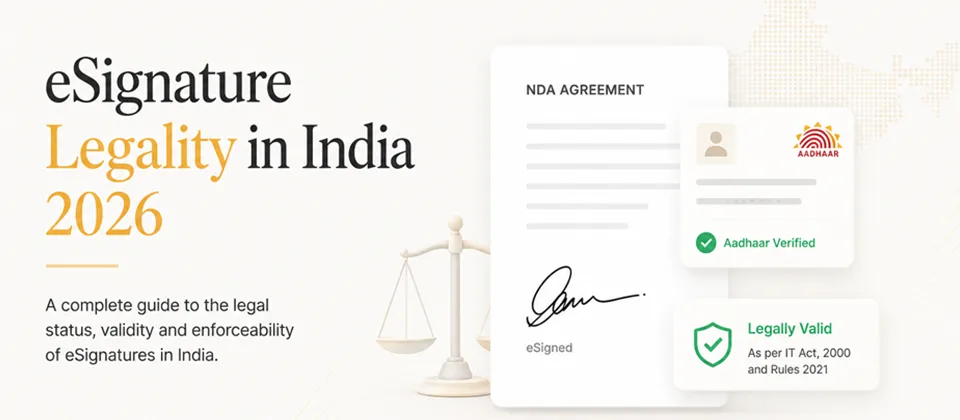
Yes. The foundation is the Information Technology Act 2000 (the “IT Act”), India’s primary law on electronic records and signatures. Three provisions do the heavy lifting:
- Section 5 gives electronic signatures legal recognition. Where any law requires a signature, that requirement is satisfied by an electronic signature applied in the manner the Central Government prescribes.
- Section 10A confirms that contracts formed through electronic means — offer, acceptance, and communication of both — are valid and enforceable, and cannot be denied legal effect merely because they were concluded electronically.
- Section 3A, added by the 2008 amendment, defines what makes an electronic signature legally reliable. This is the section everything else hangs on.
Put together: an electronically signed contract in India is enforceable, full stop — provided the signature meets the Section 3A reliability test and the document isn’t one of the specifically excluded types (more on those below).
The legal basis, in three layers
1. IT Act 2000, Section 3A — the reliability test
Section 3A says an electronic signature is legally valid if it is a technique specified in the Second Schedule of the Act and is considered reliable. A signature is treated as reliable when:
- the signature-creation data is, within the context it’s used, linked to the signatory and to no one else;
- that data was, at the time of signing, under the signatory’s control;
- any alteration to the signature after signing is detectable;
- any alteration to the information being signed is detectable.
In plain terms: the signature must genuinely tie a specific person to a specific document, and any tampering — with the signature or the document — must be catchable after the fact. This is why a tamper-evident audit trail isn’t a nice-to-have; it’s the mechanism that satisfies the law.
2. The Second Schedule — the techniques that count
Section 3A only recognises techniques the Central Government has notified in the Second Schedule. The headline one is Aadhaar eKYC-based e-authentication — the technique behind Aadhaar eSign — performed by a licensed eSign Service Provider. This is what makes Aadhaar eSign a legally specified technique rather than just “some e-signature.”
3. Bharatiya Sakshya Adhiniyam 2023, Section 63 — getting it into court
A signature being valid is one thing; proving it in court is another. That’s governed by evidence law. The Bharatiya Sakshya Adhiniyam 2023 (BSA) replaced the Indian Evidence Act 1872 with effect from 1 July 2024. Its Section 63 governs the admissibility of electronic records — it’s the successor to the old Section 65B of the Evidence Act.
Section 63 says an electronic record (your signed PDF and its audit trail) is admissible as evidence when it’s accompanied by a certificate identifying the record, describing how it was produced, and confirming the integrity of the device or system that produced it. In practice, this is the audit trail plus the certificate chain your signing platform generates.
The two techniques that actually count
Indian law distinguishes between a digital signature (Section 3) and the broader category of electronic signature (Section 3A). For everyday business, two techniques matter.
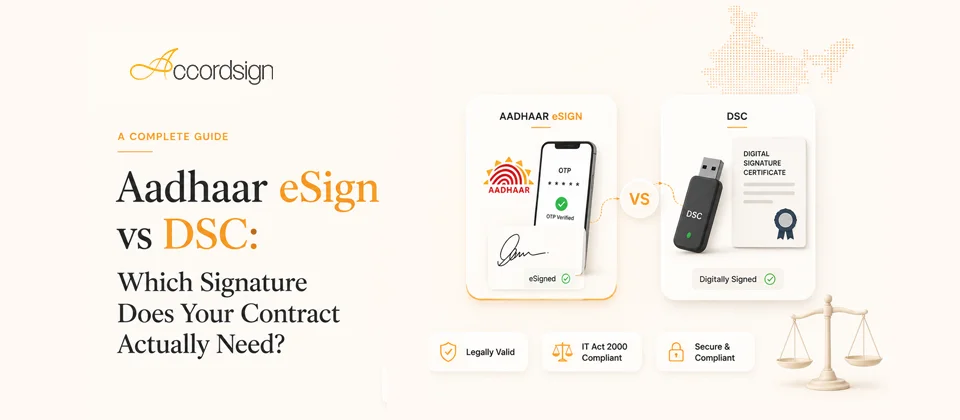
| Aadhaar eSign | DSC (Digital Signature Certificate) | |
|---|---|---|
| Legal basis | IT Act § 3A (electronic signature) | IT Act § 3 (digital signature) |
| How it works | Aadhaar eKYC + OTP to the Aadhaar-linked mobile, via a CCA-licensed ESP | Asymmetric cryptography; certificate stored on a USB token |
| What the signer needs | An Aadhaar number with a working linked mobile | A DSC token, drivers, and a supported browser |
| Typical cost | A few rupees to tens of rupees per signature | ₹1,500–3,000 one-time + annual renewal |
| Best for | NDAs, HR docs, vendor and service contracts | GST, MCA/ROC filings, customs, government tenders |
A DSC is the strongest form — a cryptographic digital signature issued by a Certifying Authority licensed by the Controller of Certifying Authorities (CCA). It’s mandatory for statutory filings.
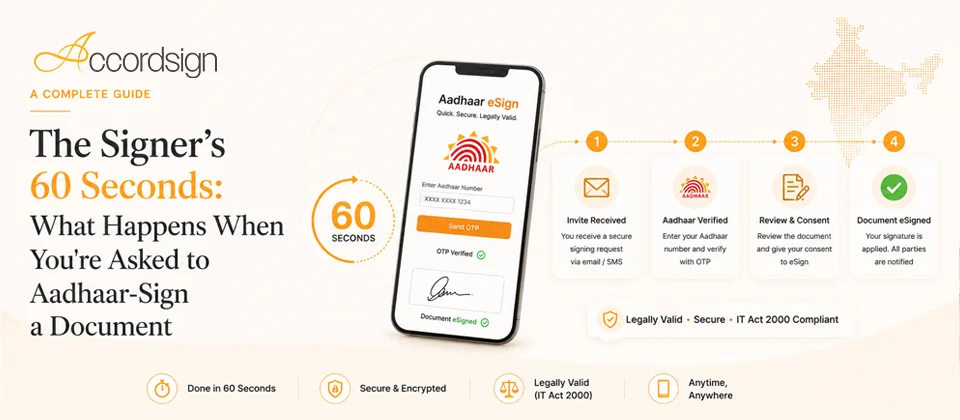
Aadhaar eSign is the workhorse for ordinary contracts: no hardware, no install, OTP-based, and a notified Second Schedule technique, so it’s legally valid under Section 3A. The cryptographic signing is performed by a CCA-licensed eSign Service Provider — we cover the mechanics in Aadhaar eSign Explained.
What about a typed name or a scanned signature?
A typed name, a drawn squiggle, or a pasted image of your signature can be a valid electronic signature — Section 3A is technology-neutral and doesn’t demand Aadhaar or a DSC for most contracts. What matters is reliability and evidence: can you prove who signed, when, and that nothing changed since?
A bare image pasted into a PDF fails that test — there’s no identity link and no tamper-evidence. The same image captured inside a workflow that records the signer’s identity, timestamp, IP, and a document hash is a much stronger record. This is exactly the difference a proper eSignature workflow makes: it turns “a picture of a signature” into “an admissible electronic record.”
What you can sign electronically
For the great majority of commercial documents, electronic signatures are valid and routine:
- HR — offer letters, employment agreements, NDAs, onboarding paperwork
- Sales & vendor — service agreements, MSAs, SOWs, vendor and partner contracts, order forms
- Finance — loan agreements, KYC forms, account-opening documents
- Commercial — consultancy agreements, partnership deeds, and rental agreements (with the appropriate stamp paper where state law requires)
If it’s a standard business contract between consenting parties, you can almost certainly sign it electronically.
What you cannot sign electronically
Here’s the part most “e-signatures are legal!” articles skip. The IT Act’s First Schedule carves out specific document types to which the Act — and therefore electronic signing — does not apply. These still require a physical, wet-ink signature:
- Negotiable instruments (other than a cheque) under the Negotiable Instruments Act 1881 — promissory notes, bills of exchange
- Powers of attorney under the Powers-of-Attorney Act 1882
- Trusts under the Indian Trusts Act 1882
- Wills and any other testamentary disposition under the Indian Succession Act 1925
- Any contract for the sale or conveyance of immovable property or any interest in such property
Two more practical constraints sit alongside the statutory exclusions:
- Statutory filings need a DSC, not a generic eSign. GST returns, MCA/ROC submissions, income-tax uploads, and customs declarations require a Digital Signature Certificate. Aadhaar eSign won’t be accepted on those portals.
- State stamp duty and registration still apply. Electronic validity doesn’t waive stamp duty or, where required, registration. A rental or property-related agreement may be electronically signable in principle but still need proper stamping under the relevant state’s law — and some states treat e-stamping differently than others.
When a document falls in the excluded list or touches property and registration, consult a lawyer before assuming an e-signature is enough.
What makes an e-signature hold up in court
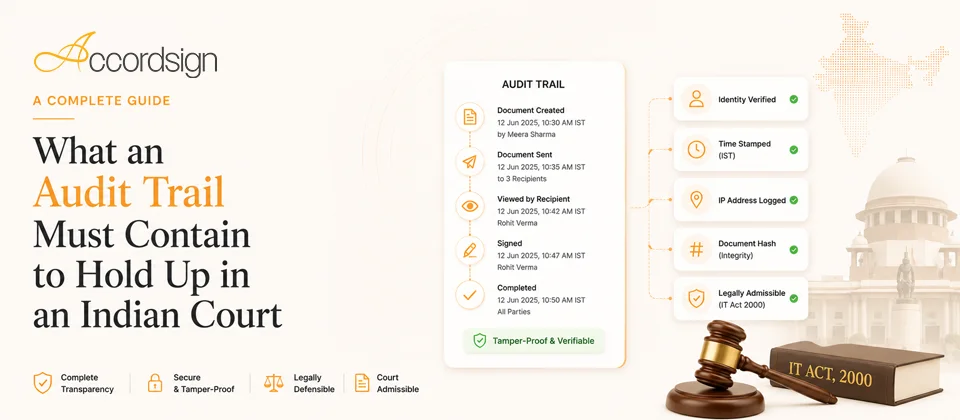
A signature you can’t prove is a signature you don’t have. To survive a challenge, your signed record needs to carry the evidence that satisfies Section 3A reliability and Section 63 admissibility. A defensible audit trail captures:
- Identity attribution — who signed, and how they were authenticated (Aadhaar OTP, email-link verification, etc.), with their IP address and device.
- Timestamp integrity — when each action happened, in a sequence that can’t be quietly rewritten.
- A document hash — a fingerprint of the exact bytes that were signed, so any later alteration to the document is detectable.
- The certificate chain — for Aadhaar eSign, the cryptographic certificate issued by the licensed ESP that ties the signature to the authenticated identity.
When those four things travel with the document, you can produce the Section 63 certificate that gets the record admitted as evidence. Indian courts routinely accept electronic records that meet these requirements; the disputes that fail tend to be the ones where the “signature” was a pasted image with no trail behind it.
A practical compliance checklist
Before you rely on an electronically signed document in India, confirm:
- ☐ The document isn’t in the First Schedule exclusion list (will, negotiable instrument, POA, trust, immovable-property conveyance).
- ☐ If it’s a statutory filing, you’re using a DSC, not a generic eSign.
- ☐ The signing technique is a recognised one — Aadhaar eSign via a licensed ESP, a DSC, or a workflow with strong identity + tamper-evidence.
- ☐ Stamp duty and registration for your document type and state are handled separately.
- ☐ Every envelope generates a complete audit trail (identity, timestamp, document hash, certificate) you can export.
- ☐ You can produce a Section 63 certificate for the record if it’s ever challenged.
Tick all six and your e-signed contracts rest on solid ground.
Bottom line
Electronic signatures are firmly legal in India. The IT Act 2000 recognises them, the Second Schedule specifies the reliable techniques, and the BSA 2023 makes the records admissible in court. For everyday business — HR, sales, vendor, and service contracts — Aadhaar eSign is the fast, legally valid default; for statutory filings, you’ll still need a DSC; and a short list of documents (wills, negotiable instruments, property conveyances, certain POAs and trusts) must stay on paper.
The throughline across all of it is evidence. A signature is only as strong as your ability to prove who made it and that nothing changed since. That’s what a proper signing workflow gives you.
Accordsign is built around exactly that — a complete audit trail on every envelope, Aadhaar eSign for India, and a standard eSignature workflow for signers anywhere. If you have a specific question about Indian eSign legality, email us — we read every one.