I read a story recently about a team that replaced a billion-dollar signing vendor in a single weekend. No drama, no eighteen-month migration project, no army of consultants — just a small team with clean systems deciding they’d had enough, and leaving. A few years ago that would have been unthinkable; the switching cost alone would have held them hostage. Today it barely slowed them down.
That story stuck with me, because I build an eSignature product for a living, and my first instinct was the uncomfortable one: if a customer can walk out on a giant in a weekend, they can walk out on us just as fast.
Most founders, on realising that, reach for the wrong lever. They try to make leaving harder — longer contracts, annual commitments, pricing that punishes you for going month to month, data that’s easy to put in and strangely difficult to get out. The whole enterprise-software playbook is quietly built around one idea: make the exit expensive enough that the customer stays even after they’ve stopped being happy.
I’ve come to believe lock-in is a confession. When a company needs a contract to keep you, it’s telling you something it hopes you won’t hear — that it isn’t confident the product alone would. Every clause designed to make leaving painful is an admission that staying isn’t compelling enough on its own.
The discount that appears at the door
You’ve probably felt the strangest version of this. The moment you threaten to leave a big vendor, they suddenly get generous. A discount materialises. An account manager who was invisible for a year calls within the hour. Terms that were “not possible” become possible. It’s meant to feel like they’re fighting for you. It should feel like an insult — because it means the fair price was always sitting there, and you only unlocked it by reaching for the door. A company that offers its best deal only when you’re leaving was overcharging you the entire time you stayed.
We chose the opposite game
When we built Accordsign, we made a deliberate decision to play the other way. We publish our pricing — you can see exactly what you’ll pay before you talk to a single person. We built a pay-as-you-go option, so you’re never forced into a subscription for a tool you only use in bursts. There’s no exit tax, no “call sales for a real number,” no discount you have to threaten your way into. The number you see is the number — on day one, and every day after.
That isn’t generosity. It’s strategy, and honestly it’s the only strategy that survives a world where leaving is easy. If a customer can walk out in a day, the thing that keeps them isn’t a contract. It’s whether the product earns its place again this morning, and tomorrow morning, and the one after that.
The boring stuff is the whole moat
So we try to compete on the unglamorous things that actually make software worth keeping. Signing that just works. Aadhaar eSign built in, so an Indian signer can sign in minutes with no hardware and no hassle. A full audit trail on every document, so trust isn’t a leap of faith. A price you don’t need to feel clever to have gotten. Support that shows up before you’re reaching for the exit, not only after. None of it is flashy. All of it is the actual moat.
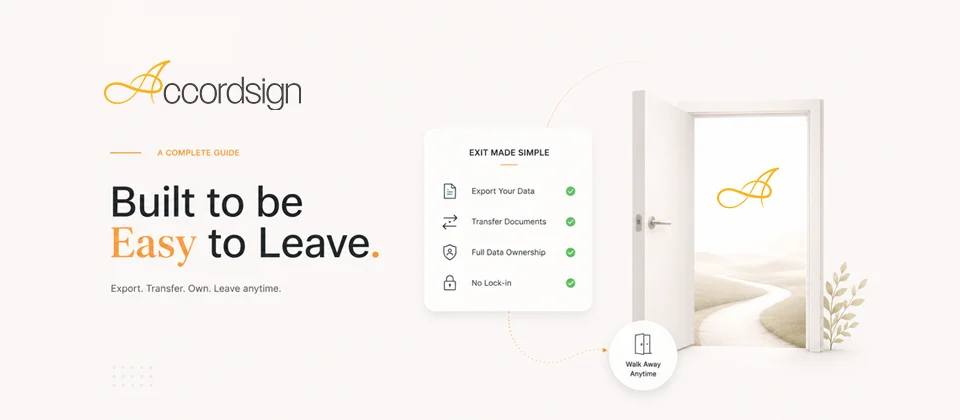
“Be the company nobody wants to leave in the first place.” That’s the whole thing, really — and notice it isn’t the company nobody can leave. That’s a cage, and people resent cages even while they sit in them. The company nobody wants to leave is a different building entirely, and it’s the only one worth working in.
We’d rather earn you every morning than trap you once. If we ever stop earning it, you should go — and I only intend to make sure you never want to.
If you want to see the number for yourself, it’s right there on our pricing page — no form, no sales call. And if you’re curious how the Aadhaar eSign piece works, we’ve written that up plainly too.
— Nivid, founder of Accordsign