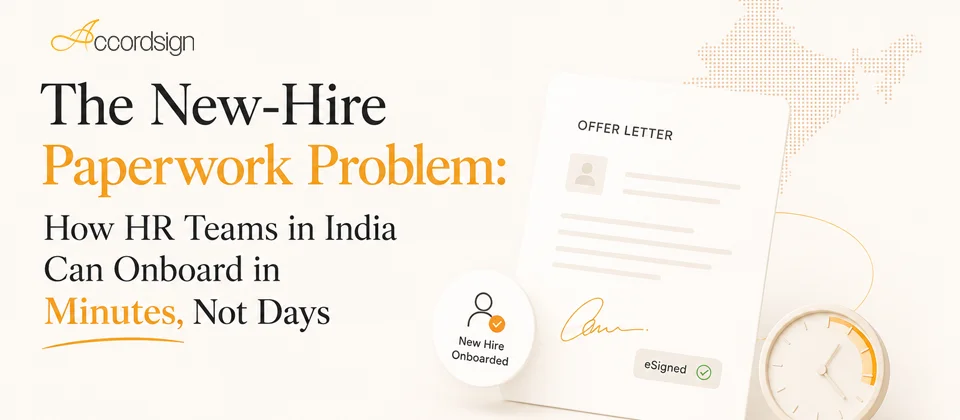
Every HR team knows the quiet dread of the offer stage. You’ve found the right candidate, the panel agrees, leadership signs off — and then the process that’s supposed to close the deal becomes the thing that risks losing it. The offer letter goes out as a PDF. It sits. You follow up. The candidate prints it “when they get to a printer,” signs it, scans it on their phone in bad lighting, and emails back a crooked, half-legible copy three days later. Meanwhile, a competing offer with a one-tap accept button lands in the same inbox. You don’t lose good candidates because your offer was worse. You lose them because your paperwork was slower.
And the offer letter is just the opening act. Behind it queues the appointment letter, the NDA, the confidentiality and IP agreements, PF and statutory forms, background-verification consent, policy acknowledgements. For a single joiner, that’s often eight to twelve documents, each needing a signature, each a separate chase. Multiply that across every hire, every month, and onboarding paperwork quietly becomes one of the most time-expensive things the HR team does — not because any single document is hard, but because the coordination is relentless.
Why the old way is slow (and where it actually breaks)
The friction isn’t the signing. It’s everything around it. Print-sign-scan assumes your new hire has a printer, a scanner, and time — three things fewer people have every year. Courier-based signing adds days and cost. Even “just email it back” creates a version-control mess: which PDF is the signed one, was every page initialled, did the witness sign, where’s the audit trail if there’s ever a dispute? HR ends up being a document-tracking service instead of a people function.
The breakages tend to cluster in three places:
- Speed — a document that should take minutes takes days and cools a candidate’s enthusiasm.
- Completeness — a form comes back missing a signature or an initial and the whole loop restarts.
- Defensibility — months later someone asks “can we prove this person actually agreed to this clause?” and the answer is a forwarded email chain nobody’s confident in.
What changes when signing goes electronic
Electronic signing collapses the loop. The document goes out as a secure link, the new hire signs on whatever device is in their hand — phone, laptop, borrowed tablet — in under a minute, and it comes back complete, with every field filled and a tamper-evident audit trail recording who signed what, when, and from where. No printer. No scanner. No chase. The offer that used to sit for four days gets signed before the candidate’s enthusiasm has a chance to cool.
For HR specifically, three things get better at once:
- Onboarding gets faster — so your best-in-class candidate experience starts at the offer, not after joining.
- Documents come back complete — because the workflow won’t let a signer skip a required field.
- Every signed document carries its own proof — so if a policy acknowledgement or an IP agreement is ever questioned, the audit trail is right there.
The India piece: Aadhaar eSign
Here’s where it gets specifically good for Indian HR teams. For a new hire who holds an Aadhaar — which is to say, effectively everyone you’re onboarding in India — Aadhaar eSign lets them sign with nothing more than their Aadhaar number and an OTP sent to their linked mobile. No hardware, no account to create, no software to install. The signature is legally valid as an electronic signature under the IT Act, 2000, and the signed record is admissible in court with its audit trail. An offer letter or appointment letter that used to take days can be signed, legally and completely, in the time it takes the candidate to read it.
It’s worth being precise about scope, because HR deals with a wide range of documents. The vast majority of onboarding paperwork — offer and appointment letters, NDAs, confidentiality and IP agreements, policy acknowledgements, consent forms — is well suited to electronic signing. A small set of documents is excluded from electronic signing under Indian law (certain instruments still require wet ink), so for anything unusual or high-value it’s always worth a quick check with your legal team. Honesty about that boundary is part of doing this properly.
What to look for when you evaluate a signing tool
If you’re an HR leader weighing this up, a few questions separate a tool that helps from one that adds another tab to your day:
- Can new hires sign from a phone with no app to install?
- Does it support Aadhaar eSign for your Indian joiners?
- Can you set a signing order when a document needs both the employee and a manager?
- Does every signed document come with an audit trail you could actually rely on in a dispute?
- And does it fit the way your team already works, rather than forcing you to learn a new platform for a task that should be simple?
The right answers turn onboarding paperwork from a multi-day chase into a same-day formality — which is exactly what it should have been all along.
Where Accordsign fits
Accordsign is built for exactly this kind of everyday signing. Send an offer letter, NDA, or onboarding pack, and your new hire signs in seconds from any device, with Aadhaar eSign built in for Indian employees and a full audit trail on every document. Approval workflows and signing order handle the documents that need more than one signature, and it works natively inside Salesforce for teams that run their business there. If your onboarding paperwork is still moving at print-and-scan speed, it doesn’t have to.
For the background on how Aadhaar eSign works, start with Aadhaar eSign, explained; and if you’re weighing which signature type fits which document, Aadhaar eSign vs DSC breaks it down.